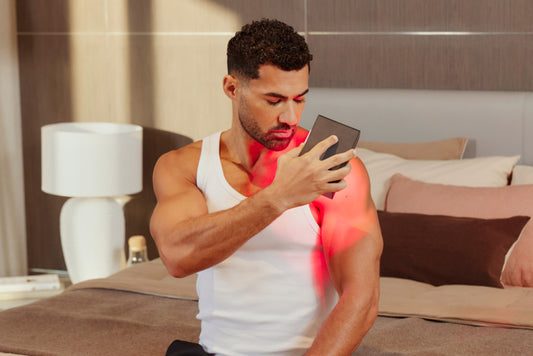
Red Light Therapy and Testosterone
Melissa Zahorujko
Online, you might see red light therapy talked about like a quick testosterone "hack." But that's not the most accurate way to think about it. Red light therapy (photobiomodulation) cannot simply switch that flips testosterone on or off, but it is a practical tool you can use to support the foundations that testosterone depends on.
In light of Men's Health Week, we're exploring what actually drives healthy testosterone rhythms in the first place.
Testosterone follows the fundamentals
For most people, testosterone is shaped by sleep quality, training load, recovery capacity, stress and overall energy availability. When those fundamental inputs are off, hormone rhythms tend to follow.
If you're biohacker-minded, think in signals and outputs. Improve the inputs first, and the output usually improves too.
But how to do it from the ground up?
This is where photobiomodulation (PBM), often called red and near‑infrared light therapy, enters the conversation. PBM is studied for how specific wavelengths of light may support cellular energy and recovery processes, which is why it's often discussed in the context of tissue repair and post-training recovery.[1][2][3]
One proposed mechanism is that red and near‑infrared light may be absorbed by cytochrome c oxidase: an enzyme involved in how mitochondria produce cellular energy. This may influence energy production and cell-to-cell signalling pathways linked to recovery and repair processes.[1][2]
Recovery is what turns training into progress
When you train, you create a "stress signal" in your muscles. The real gains happen afterward when your body repairs tissue and adapts so you come back stronger.
PBM has been studied in sports and exercise research to see if it can support that recovery process. When researchers reviewed multiple trials, they found PBM can be associated with improvements in a few areas (depending on the exact protocol, dose, and timing):
- Performance and lasting longer before fatigue: In some studies, people could do a little more work, like squeezing out extra reps, holding strength longer, or lasting longer before tiring out, especially when PBM was used before training.[4][10]
- Less "stress response" after workouts: Some trials showed smaller increases in certain post‑exercise markers linked with muscle stress and inflammation. That's why PBM is usually discussed as a recovery support tool, not a "stimulant."[4][10]
- Less DOMS (delayed onset muscle soreness) and quicker bounce‑back: A separate review focused on DOMS found PBM was linked with lower soreness ratings in the days after hard training (often around ~3–4 days later), and in some protocols, a faster return of strength within the first 24–48 hours.[11]
Yes, it turns out that red light can be a real catalyst in your recovery routine.
Sleep and circadian timing: the hormone multiplier
And recovery is closely tied to sleep.
Sleep is one of the most powerful (and most underestimated) levers for endocrine rhythms. Light exposure at the wrong time can shift those rhythms by influencing melatonin timing and duration, a key signal for sleep onset and circadian alignment.[5] That doesn't mean all light is bad at night, but the type of light (wavelength), brightness and timing do matter.
Here's where "dim red light" earns its reputation as an evening-friendly option. Studies show that melatonin suppression is most sensitive to shorter wavelengths in the blue range, with much lower sensitivity at longer wavelengths.[12][13] In other words, if your goal is to protect melatonin signalling at night, warm, amber or red light is a brilliant option.
That said, red light is not automatically "zero impact" at any intensity. High-intensity long-wavelength light can still produce small melatonin effects in some contexts.[14] So the simple rule is: at night, keep lights dim, avoid bright overhead lighting, and save the bright/cool/blue-ish light for morning and daytime.
So what's the bottom line?
- If your goal is to support healthy testosterone rhythms, start with the unsexy basics: consistent sleep, sensible training, adequate recovery, and stress management.
- From recovery to sleep, red light can help you build a routine you can actually stick to.
Set up your night and your body will thank you.
Start with the basics from our Sleep Collection (blue-light blocking, dim evening lighting, and sleep accessories), then layer in a Red Light Panel as your post-training or pre-bed wind-down ritual. Consistency is the closest thing to the rhythms humans evolved alongside nature. Bring these signals back into your life and watch your rhythms sync back in with your true nature.
BON CHARGE: This content is for general education and is not medical advice. Our products are not intended to diagnose, treat, cure, or prevent any disease. Always follow product instructions and consult a qualified healthcare professional for guidance tailored to you. Individual results may vary.
References
- de Freitas, L. F. & Hamblin, M. R. Proposed mechanisms of photobiomodulation or low-level light therapy. IEEE J. Sel. Top. Quantum Electron. 22, 7000417 (2016). https://doi.org/10.1109/JSTQE.2016.2561201
- Hamblin, M. R. Mechanisms and mitochondrial redox signaling in photobiomodulation. Photochem. Photobiol. 94, 199–212 (2018). https://doi.org/10.1111/php.12864
- Dompe, C. et al. Photobiomodulation: underlying mechanisms and clinical applications. J. Clin. Med. 9, 1724 (2020). https://doi.org/10.3390/jcm9061724
- Leal-Junior, E. C. P. et al. Effect of phototherapy (low-level laser therapy and light-emitting diode therapy) on exercise performance and markers of exercise recovery: a systematic review with meta-analysis. Lasers Med. Sci. 30, 925–939 (2015). https://doi.org/10.1007/s10103-013-1465-4
- Gooley, J. J. et al. Exposure to room light before bedtime suppresses melatonin onset and shortens melatonin duration in humans. J. Clin. Endocrinol. Metab. 96, E463–E472 (2011). https://doi.org/10.1210/jc.2010-2098
- Quirk, B. J. & Whelan, H. T. What lies at the heart of photobiomodulation: light, cytochrome c oxidase, and nitric oxide: review of the evidence. Photobiomodul. Photomed. Laser Surg. 38, 527–530 (2020). https://doi.org/10.1089/photob.2020.4905
- Keszler, A. et al. In Vivo characterization of a red light-activated vasodilation: a photobiomodulation study. Front. Physiol. 13, 880158 (2022). https://doi.org/10.3389/fphys.2022.880158
- Mitchell, U. H. & Mack, G. L. Low-level laser treatment with near-infrared light increases venous nitric oxide levels acutely: a single-blind, randomized clinical trial of efficacy. Am. J. Phys. Med. Rehabil. 92, 151–156 (2013). https://doi.org/10.1097/PHM.0b013e318269d70a
- Zein, R., Selting, W. & Hamblin, M. R. Review of light parameters and photobiomodulation efficacy: dive into complexity. J. Biomed. Opt. 23, 120901 (2018). https://doi.org/10.1117/1.JBO.23.12.120901
- Luo, W. T., Lee, C. J., Tam, K. W. & Huang, T. W. Effects of low-level laser therapy on muscular performance and soreness recovery in athletes: a meta-analysis of randomized controlled trials. Sports Health 14(5), 687–693 (2022). https://doi.org/10.1177/19417381211039766
- Tsou, Y.-A., Chang, N.-J. & Chang, W.-D. Effects of photomodulation therapy for delayed onset muscle soreness: a systematic review and meta-analysis. J. Funct. Morphol. Kinesiol. 10(3), 277 (2025). https://doi.org/10.3390/jfmk10030277
- Thapan, K., Arendt, J. & Skene, D. J. An action spectrum for melatonin suppression: evidence for a novel non-rod, non-cone photoreceptor system in humans. J. Physiol. 535, 261–267 (2001). https://doi.org/10.1111/j.1469-7793.2001.t01-1-00261.x
- Brainard, G. C. et al. Action spectrum for melatonin regulation in humans: evidence for a novel circadian photoreceptor. J. Neurosci. 21, 6405–6412 (2001). https://doi.org/10.1523/JNEUROSCI.21-16-06405.2001
- Hanifin, J. P. et al. High-intensity red light suppresses melatonin. Chronobiol. Int. 23, 251–268 (2006). https://doi.org/10.1080/07420520500521988
- Zhao, J., Tian, Y., Nie, J., Xu, J. & Liu, D. Red light and the sleep quality and endurance performance of Chinese female basketball players. J. Athl Train. 47, 673–678 (2012). https://doi.org/10.4085/1062-6050-47.6.08
- Ho Mien, I. et al. Effects of exposure to intermittent versus continuous red light on human circadian rhythms, melatonin suppression, and pupillary constriction. PLoS ONE 9, e96532 (2014). https://doi.org/10.1371/journal.pone.0096532